
Bakuchiol vs. Retinol: How the Natural Alternative Compares
Summary: Retinol is a long-studied gold standard for smoothing fine lines, but it can cause redness, dryness, sun sensitivity, and skin irritation. Bakuchiol is a gentle, plant-derived alternative that studies have shown performs comparably for the look of lines and tone, with far less irritation and no sun sensitivity, so you can use it morning and night. So, if retinol has never agreed with your skin, bakuchiol may be the active ingredient that you've been looking for.
If you've wanted the smoothing, firming results that everyone raves about with retinol, but your skin turned red, flaky, and irritated the moment that you tried it, then this article is for you! Let's discuss retinol vs. bakuchiol, what each one does, how they're different, and which one belongs in your routine.
What is retinol, exactly?
Retinol is a form of vitamin A, and it's been studied for decades. It works by encouraging skin cells to turn over more quickly and by supporting collagen, which is why it's so well known for softening the look of fine lines and evening out tone.
However, many people find retinol brings redness, dryness, peeling, and stinging, especially at first. It also makes skin more sensitive to the sun, so it's an evening-only ingredient. For many, retinol is effective but comes with too many side effects and skin irritations for us to use.
What is bakuchiol?
Bakuchiol (pronounced "buh-KOO-chee-ol") is a natural compound found in the seeds and leaves of the babchi plant, Psoralea corylifolia ~ an herb that's been treasured for centuries in Ayurvedic and traditional Chinese botanical traditions. What's interesting is that although it isn't related to vitamin A at all, it appears to gently nudge the skin in some of the same ways retinol does. That's why you'll often hear it called "nature's retinol."
And here's the very best part: it's effective and gentle. Bakuchiol is well tolerated by most skin types, including sensitive skin, it doesn't cause sun sensitivity, and it can be used both morning and night. It's also plant-derived and vegan, which makes it a perfect fit for a natural, botanical routine.
How do bakuchiol and retinol compare?
A well-known study published in the British Journal of Dermatology(Dhaliwal et al., 2019) put the two head to head in a randomized, double-blind trial. It found that bakuchiol was comparable to retinol at improving the appearance of fine lines, wrinkles, and pigmentation ~ but the retinol users reported significantly more stinging and scaling. In other words, similar visible results, with bakuchiol being much gentler.
Here are the everyday differences side by side:
Gentleness: Bakuchiol is far less likely to cause redness, dryness, or peeling. Retinol commonly does, particularly when you're starting out.
When you can use it: Bakuchiol works morning and night. Retinol is night-only, because it increases sun sensitivity.
Sun sensitivity: Bakuchiol doesn't cause it. Retinol does, so daily SPF is a must.
Track record: Retinol has decades more research behind it. Bakuchiol's evidence is newer but genuinely promising.
Suitability: Bakuchiol suits most skin types, including sensitive and reactive. Retinol can be tricky for those skin types.
So which one is right for you?
If your skin is sensitive, reactive, or easily irritated, or if you've tried retinol before and it wasn't a good fit for you, bakuchiol is definitely worth a try ~ it's the gentler road to similar goals. If you're expecting or nursing, it's a common reason people look for a retinol alternative, though I'd always encourage you to check in with your doctor about anything you're using during that time. And if retinol has always worked beautifully for you, there's no need to abandon it, but bakuchiol may still earn a place as your daytime serum. Since bakuchiol is so gentle, trying it is low-risk. Most skin simply takes to it.
But not all bakuchiol is the same
Here's something really important to know before you go shopping, because it can be the difference between bakuchiol that works and bakuchiol that does nothing at all: not all bakuchiol is created equal.
The impressive results in the studies above weren't found with just any bakuchiol. Nearly all of the major published research was done using one specific, ultra-pure form called Sytenol® A, from Sytheon. It's the form with the actual data and science behind it ~ and it's more expensive and harder to source, which is exactly why many brands don't use it.
Instead, a lot of bakuchiol products rely on unpurified seed extracts or low-quality bakuchiol that hasn't been tested for effectiveness (and can sometimes contain irritating compounds). Some don't disclose how much bakuchiol they use at all. And here's the truly eye-opening part: when independent laboratories tested a range of bakuchiol serums on the market, some were found to contain little to no actual bakuchiol ~ a few tested at 0%. So it's entirely possible to buy a "bakuchiol serum," follow every step faithfully, and see nothing, simply because there was no effective bakuchiol in the bottle to begin with.
This is why, when you're choosing a bakuchiol product, it's worth looking for one that uses Sytenol® A specifically, at a disclosed concentration (1% is the amount used in the studies and the maximum the manufacturer recommends). Those two details ~ the right form, at the right, stated percentage ~ are what separate a serum that can actually deliver the results above from one that just has a nice-sounding ingredient on the label.
Here's a summary of what the published clinical research on Sytenol® A bakuchiol has actually shown:
| Skin concern | Study result |
|---|---|
| Wrinkles | ~20% reduction in wrinkle surface area after 12 weeks |
| Hyperpigmentation | 59% reduction with bakuchiol vs. 44% with retinol (12 weeks) |
| Collagen | Increased Type I (43%), Type III (45%), and Type IV (19%) |
| Firmness | Significant improvement in elasticity and firmness |
| Hydration & barrier | Improved hydration and reduced transepidermal water loss |
| Sensitivity | Better tolerated than retinol, with less redness, flaking, and dryness |
| Acne & inflammation | Reduced acne lesions by 48% in 6 weeks |
(Sources: Dhaliwal et al., International Journal of Cosmetic Science, 2014; British Journal of Dermatology, 2024; JDD, 2020; and Sytheon clinical data. You can read more in our article on why we use Sytenol® A.)
How we use bakuchiol in our own formula
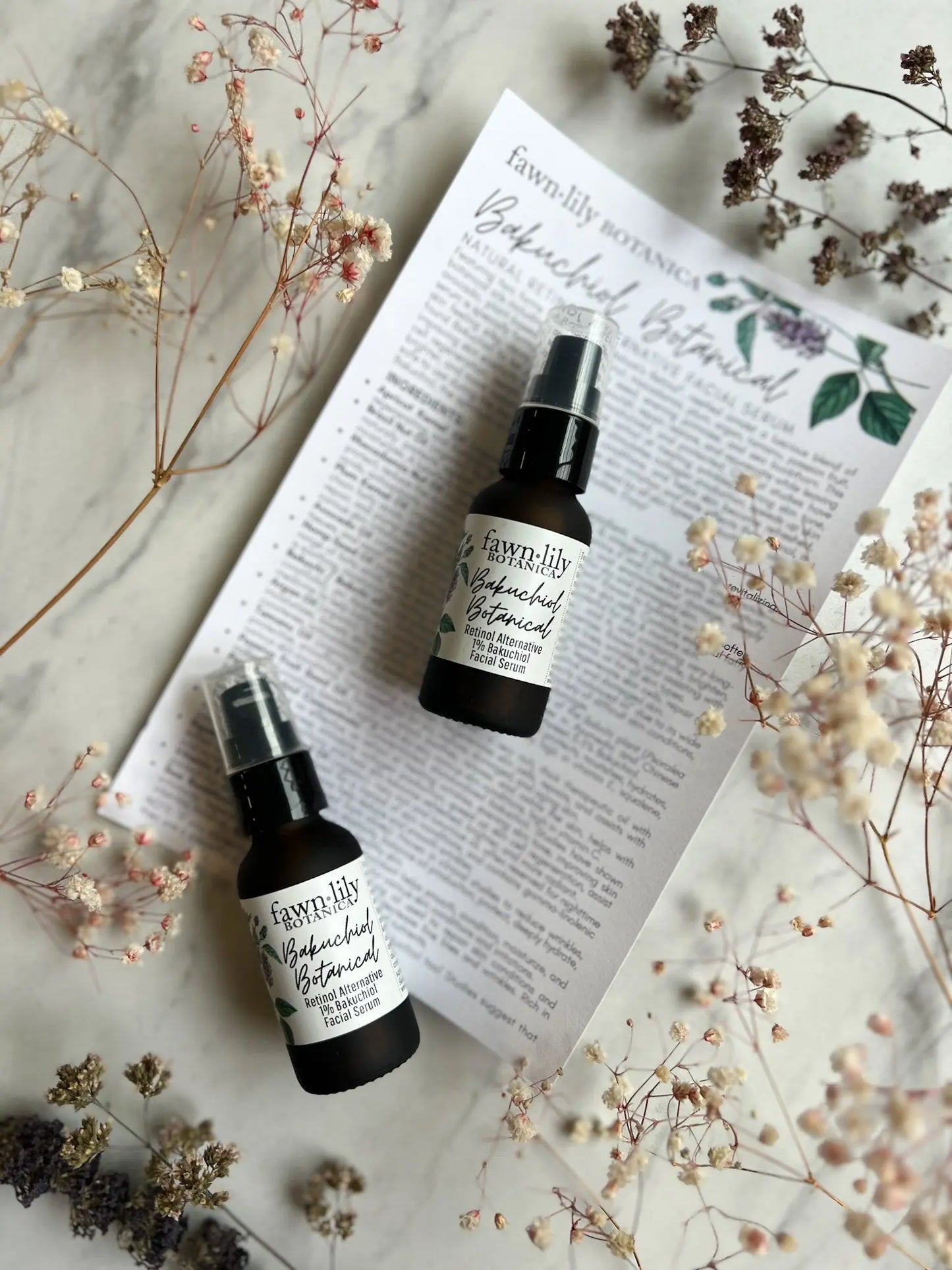
When I set out to create our Bakuchiol Botanical Facial Serum, I wanted it to capture the very best of this ingredient, so I used two forms of bakuchiol together: a standardized bakuchiol alongside traditional cold-pressed babchi oil from the whole plant. That pairing brings you the focused benefits of standardized bakuchiol plus the full-spectrum character of the babchi plant itself, all cradled in a blend of nourishing botanical oils. It's gentle enough for daily use, and it's suited to most skin types, including sensitive.
Frequently asked questions
Is bakuchiol as effective as retinol?
In the research so far, yes ~ comparably so for the look of fine lines, wrinkles, and uneven tone. The 2019 British Journal of Dermatology study found the two performed similarly, while bakuchiol caused noticeably less irritation. Retinol still has more years of study behind it, but bakuchiol's results are genuinely promising.
Can I use bakuchiol and retinol together?
You can! Many people use retinol at night and bakuchiol in the morning, and some studies suggest they complement one another nicely. Bakuchiol can also help soothe skin that retinol has left feeling a bit sensitive.
Does bakuchiol cause sun sensitivity like retinol?
No, and this is one of its loveliest advantages. Unlike retinol, bakuchiol doesn't make your skin more sensitive to the sun, so you can happily use it in the morning. Daily SPF is always a wonderful habit regardless, of course.
Is bakuchiol good for sensitive skin?
It's one of the gentlest anti-aging options out there, and it's generally well tolerated by sensitive and reactive skin. As with any new product, a little patch test on your inner arm first is always a good idea.
How long does bakuchiol take to work?
Like most gentle, natural actives, bakuchiol rewards patience. Studies typically run around twelve weeks, so give it consistent daily use for a couple of months. Slow and steady is part of what makes it so gentle.
Which bakuchiol actually works?
Look for two things: the form and the percentage. Nearly all of the published research showing bakuchiol's benefits used one specific, ultra-pure form called Sytenol® A, so that's the one with real clinical data behind it. And concentration matters just as much ~ the studies used 1%, which is also the maximum the manufacturer recommends, yet many products use less or don't disclose their percentage at all. So the bakuchiol most likely to actually work is Sytenol® A at a clearly stated 1%. If a product won't tell you which form or how much it contains, that's usually a sign it may not deliver the results you're hoping for.
The bottom line
Retinol works, but for a lot of us, the redness, sun sensitivity, and skin irritation make it unusable. Bakuchiol offers a gentle, plant-derived alternative, comfortable enough for daily use and kind even to sensitive skin. If retinol and your skin have never quite gotten along, bakuchiol might be the perfect solution.
With gratitude,
Irene ~ Owner, Formulator + Maker, Fawn Lily Botanica
Related links:
Article: Discover Bakuchiol, "Nature's Retinol"
Article: Why We Upgraded to Sytenol® A: A Better Bakuchiol Serum for Radiant, Youthful Skin
Products:
Bakuchiol Botanical Facial Serum
Perimenopause + Menopause Skincare Bundle
Quiz: